Elastic inference for sensor-saturated missions.
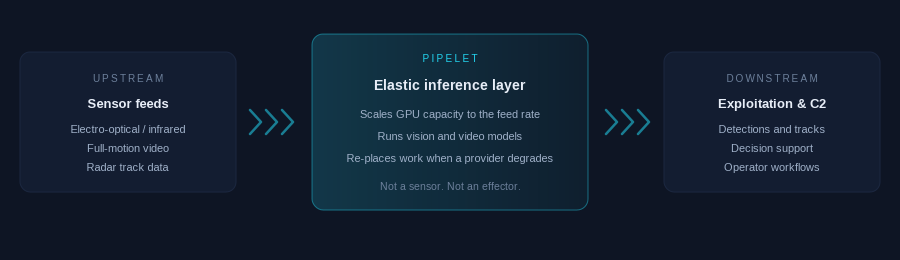
Pipelet turns GPU capacity across permitted providers into one elastic pool for bursty, high-volume sensor processing.
Tracking & Targeting; Enabling Technologies.
Pipelet supports Tracking & Targeting with elastic AI inference and Enabling Technologies as compute for modeling and simulation.
| Mission need | Pipelet contribution |
|---|---|
| High-volume EO/IR and full-motion video processing | Frame-sequence inference for continuous sensor exploitation. |
| Surge capacity during elevated activity | Autoscaling across providers as processing demand changes. |
| Resilience against provider or region loss | Automated re-placement onto healthy capacity. |
| Avoiding vendor lock-in on compute | Portable workloads across heterogeneous accelerators and providers. |
| Cost control at architecture scale | Scheduling against live price and availability. |
Self-assessed readiness.
Readiness is scoped to the target environment.
TRL 8
The full stack runs ~10,000 videos per day, autoscales roughly 3×, sustains about 80% utilization, and fails over across providers.
TRL 5
Proven commercially, but not yet demonstrated with government data in an accredited environment.
A realistic first increment.
Start with a bounded prototype using representative unclassified data.
Technical exchange
Feed rates, model class, latency budget, data-residency constraints.
Benchmark
Compare a representative workload with the current baseline.
Constrained deployment
Deploy into a designated environment while accreditation proceeds.
Operational increment
Sustained processing role with surge and failover exercised under load.
Available for Other Transaction Agreements, prototypes, SBIR/STTR, and subcontracting.
Open to a technical exchange.
Send the feed rate, model class, latency budget, and data constraints.