A control plane for compute you don't own.
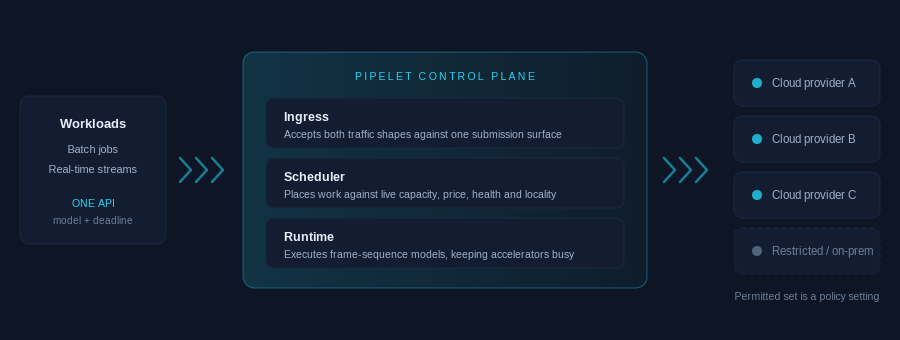
Submit to one API. Pipelet selects the provider, region, and accelerator, then re-places work as conditions change.
Autoscaling is the product.
Pipelet's production footprint swings roughly 3× between trough and peak, holding utilization near 80% rather than paying for idle reserved capacity.
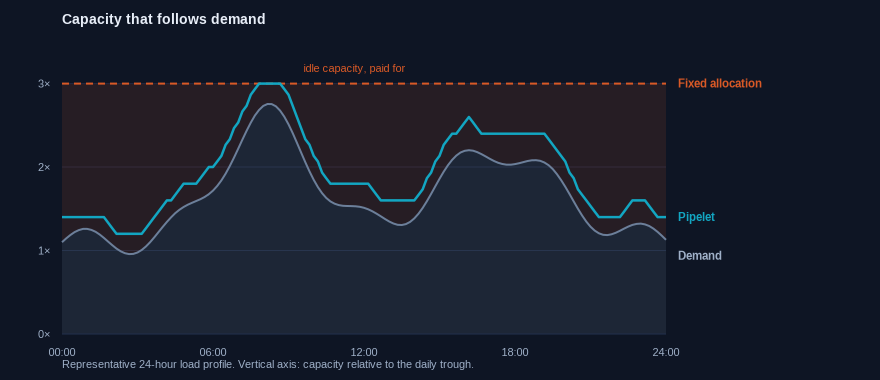
- Scale to demand: capacity acquired and released as the queue moves.
- Cross-provider burst: when one provider is queue-limited, capacity comes from another.
- Utilization as a target: the scheduler optimizes for keeping acquired accelerators busy.
- Automated failover: degradation triggers re-placement onto healthy capacity.
Built for frame sequences.
Pipelet is optimized for workloads where cost scales with frames, resolution, duration, and temporal ordering.
| Class | Shape | What Pipelet optimizes |
|---|---|---|
| Video generation | Batch, throughput-bound | Queue depth and GPU saturation |
| Video understanding | Streaming, continuous feeds | Steady-state throughput per stream |
| Vision inference | Real-time, latency-bound | Tail latency; reserved headroom |
| World-model rollout | Iterative prediction | Weight residency and state reuse |
| Chained multimodal | Multi-stage, mixed modality | Stage co-location |
Where the stack can run.
The same software can run across Pipelet-managed, customer-owned, or policy-restricted infrastructure.
Managed multi-cloud
Pipelet operates the control plane and provider relationships.
Customer-tenanted
Schedules only across the customer's cloud capacity.
Restricted environment
Restricts placement to approved providers, regions, and accelerators.
Bring us a workload.
Send a representative job and deadline to compare against your current stack.